
Black Accent Wall: Why Black Walls Are Defining Modern Interior Design
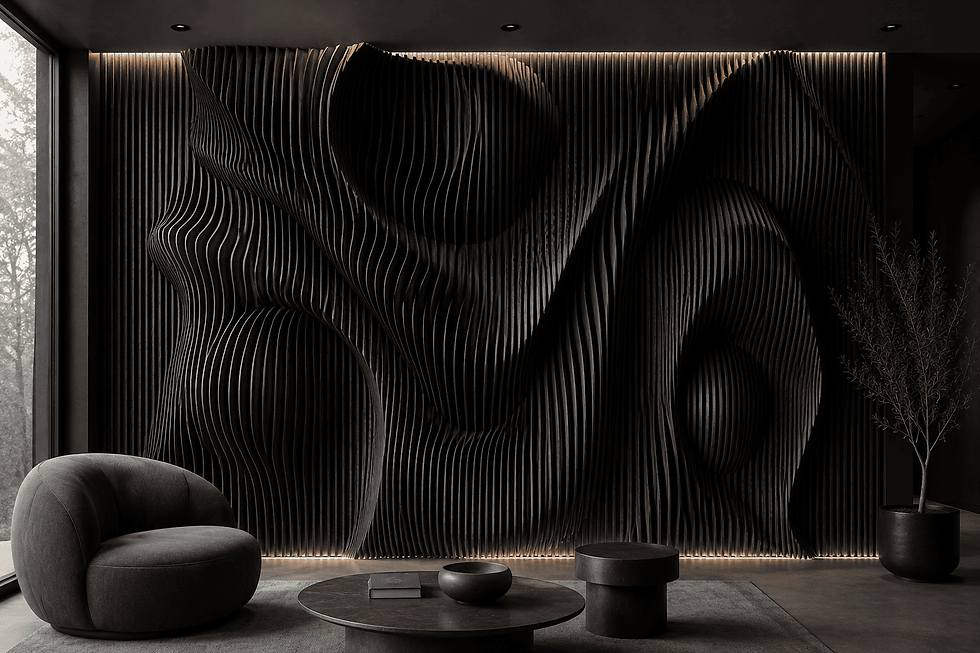
For years, white walls dominated contemporary interior design. They offered simplicity, versatility, and a sense of openness. But today's most influential architects and designers are moving in a different direction.
One of the strongest trends shaping residential and commercial interiors is the rise of the Black Accent Wall. More than just a color choice, a modern black feature wall has become a statement of architecture, craftsmanship, and design sophistication.
At Zorka Furniture, we work with architects, designers, developers, and business owners throughout the United States. Across luxury homes, corporate offices, hotels, and retail environments, we continue to see growing demand for black wood wall panels, sculptural surfaces, and custom parametric installations that transform ordinary walls into architectural focal points.
The Evolution of Design: Welcome to the Age of Parametricism
Every era has its defining design language.
Classical architecture emphasized symmetry and proportion. Modernism celebrated simplicity and functionality. Minimalism reduced spaces to their essential elements.
Today, many leading design studios consider Parametricism to be the next major movement in architecture and interior design.
The concept was largely popularized by the legendary architect Zaha Hadid, whose groundbreaking work challenged traditional architectural forms. Using advanced computational design tools, architects began creating fluid geometries inspired by nature rather than rigid straight lines.
These flowing forms can now be seen everywhere—from museums and airports to luxury hotels and corporate headquarters.
As parametric architecture continues to influence interior design, parametric wall design has emerged as one of the most exciting ways to introduce this aesthetic into everyday spaces.
Why Black Is Dominating Contemporary Interior Design
Designers often refer to black as the ultimate contrast color.
Rather than making a room feel smaller, a carefully designed modern black accent wall creates depth, visual interest, and a sense of luxury. Black absorbs light differently than lighter finishes, allowing textures and architectural details to become more prominent.
This is one reason why black has become increasingly popular in:
Luxury residences
Corporate offices
Boutique hotels
Wellness centers
Restaurants
Retail spaces
A well-designed black feature wall immediately creates a focal point and helps define the identity of a space.
Black Accent Wall Ideas for Modern Homes
Homeowners today are looking for alternatives to traditional painted walls.
Some of the most popular black accent wall ideas include:
Textured black wood walls
Parametric wooden installations
Sculptural wall panels
Slatted wood feature walls
Backlit architectural panels
Custom 3D wood wall panels
Unlike paint or wallpaper, architectural wall systems introduce depth, shadow, and movement.
A black wall becomes more than a surface—it becomes part of the architecture.
Black Wood Wall Panels: Where Natural Materials Meet Modern Design
One of the biggest misconceptions about black interiors is that they hide natural materials.
In reality, the most sophisticated projects often combine black finishes with exposed wood grain.
Modern black wood wall panels are frequently finished using black oils rather than opaque paint. This approach preserves the natural texture of the wood while enhancing its depth and character.
For multi-layer plywood constructions, the exposed layers create an additional visual element that designers increasingly appreciate.
The result is a wall that feels both contemporary and organic.
At Zorka Furniture, many of our custom installations intentionally highlight the layered structure of the material, allowing craftsmanship to remain visible while achieving a dramatic black finish.
Parametric Wall Design: The Future of Architectural Interiors
Traditional wall treatments are generally flat.
Parametric walls are different.
Using advanced digital modeling software, designers create flowing surfaces that appear to move across the wall. Curves emerge from hundreds of precisely manufactured wooden elements, creating dynamic compositions that change throughout the day as light interacts with the surface.
This is why parametric wall design has become so popular among architects and interior designers seeking unique architectural features.
Instead of decorating a wall, designers are now sculpting it.
The result is an installation that functions simultaneously as art, architecture, and interior design.
Decorative Wood Wall Panels as Architectural Features
Modern interiors increasingly rely on architectural elements rather than decorative accessories.
This shift has led to growing demand for decorative wood wall panels and custom installations that define a space through form and texture.
Many designers now view walls as opportunities to create visual experiences rather than simply enclosing a room.
Custom architectural wall systems can:
Improve visual depth
Introduce texture
Reinforce branding
Create memorable focal points
Enhance perceived luxury
These architectural wall features are particularly effective in commercial environments where first impressions matter.
Modern Wall Paneling Trends in 2026
Looking ahead, several major trends are shaping the future of modern wall paneling.
Organic Geometry
Designers continue moving away from rigid geometric patterns in favor of fluid forms inspired by nature.
Sculptural Surfaces
Flat walls are being replaced by dimensional installations that create movement and shadow.
Natural Materials
Wood remains one of the most desirable materials due to its warmth, sustainability, and timeless appeal.
Dark Finishes
Black, charcoal, and deep earth tones continue gaining popularity across luxury interiors.
Integrated Lighting
Architectural lighting is increasingly used to emphasize textures and enhance three-dimensional forms.
Together, these trends are redefining what contemporary wall design can be.
Where a Black Feature Wall Works Best
Living Rooms
A black accent wall living room design creates a dramatic focal point while adding warmth and sophistication.
Home Offices
Dark architectural surfaces provide a professional and contemporary backdrop for modern workspaces.
Reception Areas
Many businesses use black feature walls behind reception desks to create a strong first impression.
Hotels and Hospitality
Luxury hotels frequently utilize textured black walls to establish atmosphere and strengthen their visual identity.
Retail Spaces
A sculptural black wall can enhance product presentation and create a memorable customer experience.
Why Designers Continue Choosing Black
Design trends change constantly, yet black remains remarkably timeless.
Professional designers consistently choose black because it:
Highlights architectural geometry
Enhances contrast
Creates visual depth
Complements natural materials
Works across both residential and commercial interiors
Creates an unmistakable sense of luxury
When paired with texture, lighting, and craftsmanship, black becomes one of the most powerful design tools available.
The Future of Luxury Interior Wall Design
The popularity of the Black Accent Wall reflects a larger transformation within contemporary design.
Today's most memorable interiors are no longer defined solely by furniture or finishes. Instead, they are shaped by architectural elements that create emotion, atmosphere, and visual impact.
Inspired by the principles of Parametricism and the pioneering work of Zaha Hadid, architects and designers continue exploring new ways to integrate sculptural forms into everyday environments.
At Zorka Furniture, we believe walls should do more than separate spaces.
They should shape experiences.
Whether incorporated into a luxury residence, a corporate headquarters, a hotel lobby, or a retail environment, a custom parametric black wall creates an architectural statement that remains relevant for years to come.


Comments