
Baby Crib & Nursery Design: The Complete Guide to Creating a Safe, Calm and Modern Nursery
Updated: Aug 13
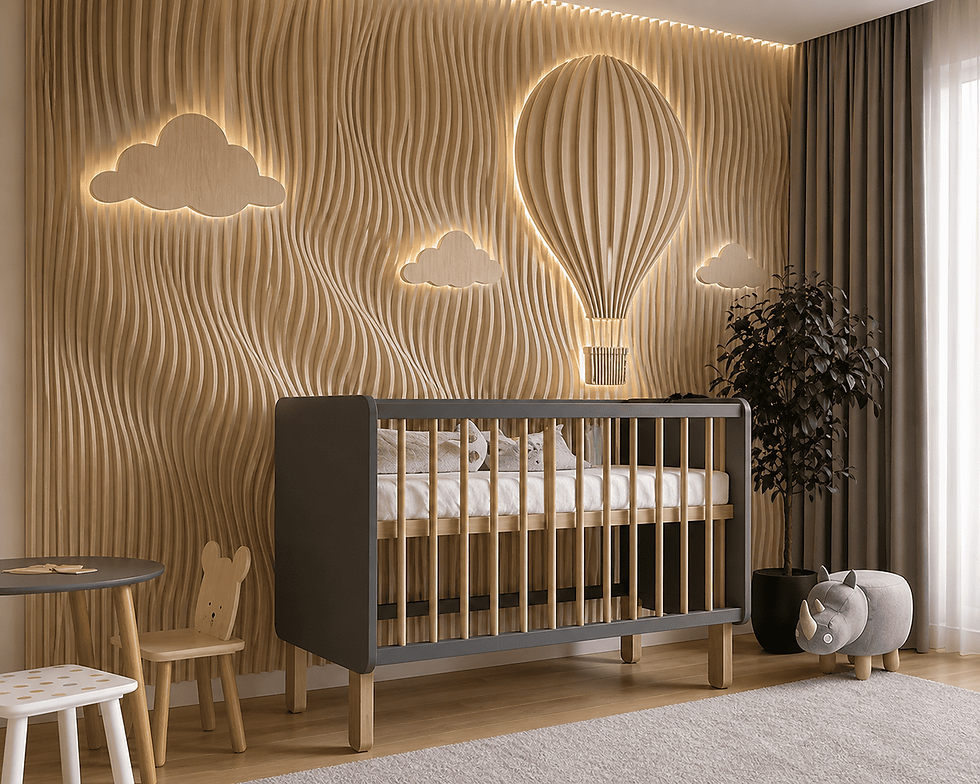
Designing a nursery is one of the most personal interior projects in a home.
Unlike most rooms, a nursery must satisfy several requirements simultaneously. It should feel calm and welcoming, function efficiently for parents, adapt as the child grows, and—above everything else—be organized around safety.
At the center of that environment is the baby crib.
The crib naturally becomes one of the most important pieces of furniture in the room, both functionally and visually. But creating a successful nursery requires more than selecting a beautiful crib and placing it against an empty wall.
The position of the crib, surrounding furniture, lighting, wall design, materials, circulation, storage, and visual stimulation all influence how the room functions.
A well-designed nursery should therefore be considered as one complete interior rather than a collection of individual products.
This guide explores how to choose a baby crib, how to organize the surrounding space, which design decisions matter most, and how architectural elements such as custom feature walls can create a nursery that remains beautiful long after the crib itself is no longer needed.

Safety Comes Before Style
Beautiful nursery design should always begin with one principle:
The sleeping environment must be designed around safety first.
For infant sleep, the U.S. Consumer Product Safety Commission recommends a firm, flat sleep surface in a crib, bassinet, or play yard, with a properly fitted sheet and without pillows, blankets, padded crib bumpers, or other soft objects in the sleep space.
This means nursery styling should happen around the crib—not inside it.
Instead of filling the crib with decorative objects for photographs, designers can create visual character through:
Wall treatments
Lighting
Furniture
Artwork positioned safely away from the crib
Material selection
Color
Architectural texture
The crib itself should remain visually calm and functionally simple.
Choosing the Right Baby Crib
A baby crib should never be selected on appearance alone.
Before considering color, wood tone, or design style, evaluate whether the crib is appropriate for its intended use and complies with applicable U.S. safety requirements.
Important considerations include:
Structural stability
Appropriate mattress fit
Secure assembly
Strong crib sides and components
Appropriate slat construction
Reliable mattress support
Durable hardware
Manufacturer instructions and warnings
Cribs sold in the United States are subject to federal safety requirements covering areas including structural integrity, slat strength, mattress support, hardware, and prevention of incorrect assembly.
Baby Crib Buying Priorities
Priority | Why It Matters |
Safety Compliance | The crib should meet applicable U.S. safety requirements |
Structural Stability | Prevents movement, loosening, or instability |
Mattress Fit | Helps prevent unsafe gaps around the mattress |
Quality Construction | Supports reliable long-term use |
Ease of Access | Makes everyday care more practical |
Adjustable Mattress Position | Can improve usability as the child develops, when provided by the manufacturer |
Timeless Design | Allows the nursery to evolve without redesigning the entire room |
A visually impressive crib that compromises practical requirements is not good design.
The strongest nursery interiors make safety and aesthetics support each other.
The Crib Should Not Carry the Entire Design
One of the most common design mistakes is trying to make the baby crib itself the most decorative object in the room.
A better approach is usually more restrained.
Choose a crib with:
Balanced proportions
A finish that complements the room
Clean, easy-to-understand construction
A design capable of working with future furniture
Then allow the surrounding architecture to create personality.
This creates a nursery that feels more sophisticated and makes future transitions easier when the crib is eventually replaced by a toddler or standard bed.
Where Should the Baby Crib Go?
Placement affects both function and composition.
Before deciding where the crib looks best, evaluate the room practically.
Consider:
Windows
Window coverings and cords
Heating and cooling sources
Electrical elements
Doors
Circulation
Other furniture
Direct sunlight
Accessibility for parents
The crib should have enough surrounding space for comfortable access without creating awkward circulation.
The safest and most practical location may not always be the first wall that looks best in a rendering.
That is why nursery design should begin with a floor plan rather than decoration.
Designing the Nursery Around the Crib
Once a suitable crib location is established, the rest of the room can be organized around it.
A typical nursery may include:
Baby crib
Changing area
Storage
Comfortable chair or lounger for a parent
Side table
Lighting
Rug
Feature wall
Future furniture space
The objective is to create clear functional zones while keeping the room visually calm.
Nursery Layout: Think in Zones
A well-planned nursery can be divided into several functional areas.
Zone | Primary Function |
Sleep Zone | Crib and calm surrounding environment |
Care Zone | Changing and everyday baby care |
Storage Zone | Clothing, supplies, and accessories |
Parent Zone | Chair or lounge seating |
Circulation Zone | Clear movement between functions |
Visual Zone | Wall, lighting, and architectural focal point |
Thinking in zones helps prevent the common mistake of filling every available wall with furniture.
Negative space is useful.
A nursery should feel breathable rather than crowded.
The Wall Behind the Baby Crib
The wall surrounding the crib naturally receives a great deal of visual attention.
This makes it tempting to decorate heavily.
But in modern nursery design, a more architectural approach often creates a stronger result.
Instead of numerous small decorative elements, designers can use:
Subtle wood texture
Shallow architectural relief
Soft vertical geometry
Natural finishes
Restrained sculptural patterns
Carefully controlled color
The result can provide visual interest without making the room feel busy.
Traditional Nursery Decor vs. Architectural Nursery Design
Traditional Approach | Architectural Approach |
Many small decorations | Fewer, stronger elements |
Trend-driven themes | Timeless materials |
Graphic wall stickers | Physical texture |
Multiple bright colors | Controlled palette |
Nursery-specific appearance | Design that can evolve with age |
Temporary decoration | Long-term architectural elements |
Neither approach is inherently wrong.
But homeowners investing in a highly designed interior may prefer architectural elements that can remain relevant after the nursery phase ends.
Why Texture Works Well in a Nursery
Texture introduces visual interest without depending on bright color.
This is particularly valuable in interiors designed around softer palettes.
A three-dimensional wooden wall can create subtle changes in:
Light
Shadow
Depth
Rhythm
Material character
During daylight hours, natural light reveals the surface gently.
In the evening, softer lighting can produce a warmer and quieter visual effect.
The key is restraint.
A nursery typically benefits from controlled geometry rather than excessively deep or visually aggressive patterns.
The Designer's Perspective: Design for the Next Room Too
A baby crib is temporary.
The architecture is not.
This is one of the most important ideas when investing in a custom nursery.
Ask yourself:
Will this room still look good when the crib is gone?
A heavily themed nursery may require another renovation several years later.
A more timeless interior based on proportion, natural materials, subtle texture, and quality craftsmanship can evolve much more easily.
The crib can become a bed.
The changing table can disappear.
Artwork can change.
Furniture can move.
But a well-designed architectural wall can remain.
This is why the strongest nursery designs often feel less like temporary children's rooms and more like beautiful interiors that happen to be designed for a baby.

Materials, Color & Lighting in Modern Nursery Design
Once the baby crib and basic room layout are established, the next step is creating the atmosphere.
This is where material, color, texture, and lighting become important.
A sophisticated nursery does not need to rely on stereotypical children's themes or excessive decoration. In many contemporary interiors, the strongest approach is considerably more restrained: natural materials, soft colors, thoughtful lighting, and one or two architectural elements that give the room identity.
The objective is to create a space that feels intentional today but can also evolve naturally as the child grows.
Choosing Materials for a Modern Nursery
Materials should be considered from both practical and aesthetic perspectives.
A nursery contains surfaces that will be touched, cleaned, and used regularly. Finishes should therefore be durable, appropriate for interior use, and easy to maintain.
For architectural elements, designers may consider:
High-quality wood-based materials
Natural wood surfaces
Smooth painted finishes
Low-emission interior coatings
Durable, easy-to-clean finishes
Carefully finished edges and surfaces
For products used around children, always follow the product manufacturer's safety information and applicable requirements rather than assuming that a material is appropriate simply because it is described as "natural."
Natural Wood in Nursery Interiors
Wood works particularly well in nursery design because it introduces warmth without requiring strong color or excessive decoration.
It can be used for:
The baby crib
Storage furniture
Shelving
Feature walls
Architectural panels
Decorative elements
Flooring
In contemporary interiors, wood is often paired with warm white, beige, cream, muted gray, or other restrained colors.
This creates a room that feels residential and sophisticated rather than overly themed.
Material & Design Comparison
Design Direction | Visual Effect | Best Application |
Natural Wood | Warm and timeless | Crib, furniture, feature walls |
Light Wood Tones | Soft and contemporary | Modern and Scandinavian nurseries |
Warm White | Clean and calm | Walls and cabinetry |
Matte Painted Surfaces | Refined and minimal | Architectural features |
Soft Textiles | Adds comfort | Rugs, curtains, parent seating |
Sculptural Wood | Architectural character | Feature walls |
The strongest nursery interiors usually combine several textures while keeping the overall palette controlled.
Choosing a Nursery Color Palette
There is no rule requiring a nursery to be pink, blue, or brightly colored.
Contemporary nursery design increasingly favors palettes capable of remaining relevant as the child grows.
Popular directions include:
Warm white
Cream
Beige
Light natural wood
Muted earth tones
Soft green
Warm gray
Subtle contrasting accents
Instead of using many colors throughout the room, consider establishing one primary neutral palette and introducing smaller accents through furniture, textiles, artwork, and objects that can easily be changed later.
Neutral Doesn't Have to Mean Boring
A common concern is that a neutral nursery will feel empty or unfinished.
Texture solves this problem.
Imagine two walls painted exactly the same warm white.
One is completely flat.
The other contains subtle three-dimensional geometry.
Even without introducing another color, the second wall changes throughout the day as light moves across its surface.
That creates visual complexity without relying on busy graphics.
This is one reason textured feature walls can work so well in modern nursery interiors.
Designing a Feature Wall Behind the Baby Crib
The wall behind the baby crib is often the natural focal point of the nursery.
But this area should be approached carefully.
Rather than relying on loose or projecting decorative objects immediately around the sleep space, visual interest can be developed through the architectural treatment of the wall itself, provided the installation is appropriately designed and securely constructed.
Possible design directions include:
Shallow vertical relief
Soft wave patterns
Minimal geometric texture
Natural wood compositions
Subtle parametric geometry
Painted architectural relief
The design should feel calm enough to support the room rather than dominate it.
How Deep Should a Nursery Feature Wall Be?
For most nurseries, dramatic depth is unnecessary.
The geometry can remain relatively shallow while still creating meaningful interaction with light.
Wall Style | Visual Intensity | Nursery Application |
Flat Painted Wall | Minimal | Simple, timeless interior |
Shallow Linear Texture | Low | Small or minimalist nursery |
Soft 3D Relief | Medium | Feature wall behind crib |
Gentle Parametric Pattern | Medium | Custom contemporary nursery |
Deep Sculptural Geometry | High | Usually better suited to larger non-nursery spaces |
In a nursery, refinement usually works better than visual excess.
Wood Feature Wall vs. Wallpaper
Both can create an effective nursery, but they serve different purposes.
Wallpaper | |
Physical three-dimensional depth | Primarily graphic depth |
Architectural character | Decorative character |
Interacts strongly with light | Depends primarily on pattern |
Can remain relevant as room evolves | Often easier to replace |
Custom geometry possible | Wide selection of printed designs |
Higher architectural impact | Usually simpler to implement |
Wallpaper may be ideal for homeowners who want a temporary theme.
A custom architectural wall makes more sense when the goal is to create a permanent element that can remain after the nursery is converted into a child's bedroom, office, or another space.
Small Nursery vs. Large Nursery
Room size should directly influence design decisions.
Small Nursery
In a compact nursery:
Keep the feature wall relatively shallow
Use lighter finishes
Limit the number of large furniture pieces
Preserve clear circulation
Use vertical geometry to emphasize height
Avoid unnecessary visual clutter
The objective is to create character without making the room feel smaller.
Large Nursery
A larger room provides more freedom.
Designers can introduce:
Larger-scale feature walls
A dedicated parent seating zone
More storage
Wider furniture spacing
Larger rugs
More substantial architectural elements
However, additional space does not mean every area needs to be filled.
Negative space remains an important part of good interior design.
Nursery Lighting: Think in Layers
A single bright ceiling fixture rarely creates the most comfortable or versatile nursery.
Layered lighting provides much greater control.
A nursery may combine:
General Lighting
Provides overall illumination for everyday use.
Task Lighting
Useful near changing, storage, or parent seating areas.
Soft Ambient Lighting
Creates lower-intensity illumination when full room lighting is unnecessary.
Architectural Lighting
Can emphasize a feature wall or other design element.
Different activities require different levels of illumination, so flexibility is more useful than designing the entire room around one dramatic light source.
Lighting and a Textured Wall
Directional light can dramatically change the appearance of a three-dimensional wall.
Light striking the surface from an angle produces highlights and shadows, making relatively shallow geometry appear deeper.
For a nursery, this effect should generally remain subtle.
The goal is not to turn the room into a dramatic hotel lobby.
It is to create gentle architectural depth.
Warm vs. Neutral Lighting
Lighting Direction | Visual Character |
Warm Light | Soft, residential, comfortable |
Neutral Light | Clean and contemporary |
Strong Directional Light | Dramatic shadows |
Diffused Light | Softer and more uniform |
Indirect Light | Subtle ambient atmosphere |
The best lighting strategy depends on the materials, colors, and functional needs of the room.
For nighttime routines, parents may also find lower-intensity lighting useful so the room does not always need to be illuminated at full brightness.
Storage Is Part of Nursery Design
Nurseries accumulate objects quickly.
Clothing, diapers, bedding, supplies, toys, and everyday accessories can create visual clutter even in a beautifully designed room.
Storage should therefore be planned from the beginning.
Useful options include:
Closed cabinetry
Drawers
Dressers
Built-in storage
Shelving positioned appropriately for the room
Baskets or organizers stored away from the crib
From a visual perspective, closed storage is particularly effective because it allows the architecture and primary furniture to remain dominant.
The Parent Seating Area
Nursery design should not focus exclusively on the baby.
Parents may spend significant amounts of time in the room, so comfortable adult seating deserves its own zone.
A parent chair or lounger should be positioned with consideration for:
Comfortable access
Lighting
Nearby storage
Circulation
Relationship to the crib
Available floor space
A small side table may also be useful where appropriate.
The result should feel integrated rather than like an extra chair placed wherever space remained.
Designing a Nursery That Can Grow With the Child
One of the strongest arguments for a restrained architectural approach is longevity.
Consider what happens when the baby crib eventually leaves the room.
A well-planned nursery can transition through several stages:
Nursery Stage | Possible Evolution |
Infant | Baby crib + changing area |
Toddler | Toddler bed + open play space |
Young Child | Standard bed + storage |
Older Child | Desk + expanded storage |
Future Use | Bedroom, office, or flexible room |
Permanent design elements should ideally work across several of these stages.
This is why timeless materials and architectural texture can offer more flexibility than a highly specific nursery theme.
Common Nursery Design Mistakes
1. Designing Only for Photographs
A nursery may look beautiful online while functioning poorly in daily life.
Circulation, storage, access, cleaning, and safety matter more than creating a perfect photograph.
2. Overdecorating the Crib Area
The crib does not need to be filled or surrounded by decorative objects to become the focal point.
Keep the sleep space simple and develop the design through the room itself.
3. Buying Furniture Before Planning the Layout
Large furniture can quickly consume a small nursery.
Measure the room and establish circulation before ordering the crib, dresser, chair, and storage pieces.
4. Using Too Many Themes
Clouds, animals, stars, rainbows, strong patterns, multiple colors, and decorative lettering can all work individually.
Using everything simultaneously can make the room visually chaotic.
Choose a clear direction and edit carefully.
5. Ignoring Future Use
A nursery changes quickly.
Designing every permanent surface around an infant-specific theme may result in another renovation sooner than necessary.
6. Making the Feature Wall Too Aggressive
Deep waves and highly complex geometry may be impressive, but a nursery generally benefits from a softer architectural language.
Good custom design means adapting the idea to the room rather than simply maximizing visual impact.
Designer's Rule: Let One Element Lead
A room rarely needs five focal points.
Decide what should visually lead the nursery.
It might be:
The baby crib
A custom feature wall
A beautiful light fixture
A large window
A distinctive piece of furniture
Then allow the other elements to support it.
For example, if a sculptural wood wall is the primary architectural feature, the crib itself may look better with relatively simple geometry and a restrained finish.
This creates hierarchy.
And hierarchy is one of the differences between a room that is merely decorated and an interior that feels professionally designed.
Custom Nursery Feature Walls
For projects requiring something more individual than standard panels or wallpaper, a custom feature wall can be designed specifically around the room.
The design can respond to:
Exact wall dimensions
Ceiling height
Crib location
Doors and windows
Desired maximum depth
Existing furniture
Material palette
Lighting
Future room use
A three-dimensional model can then be used to evaluate proportions before manufacturing.
This approach allows the wall to belong to the architecture rather than simply being fitted into whatever space remains.
The Best Nursery Design Feels Effortless
A successful nursery should not feel as though every square inch was designed to attract attention.
The most sophisticated spaces usually have moments of visual interest surrounded by areas of calm.
The crib provides function.
Storage provides organization.
A chair provides comfort.
Lighting provides flexibility.
And architectural texture can provide identity.
When each element has a clear role, the room becomes easier to use and visually more coherent.
That is ultimately the goal of modern nursery design: not more decoration, but better decisions.

Baby Crib Safety and Design: Where Aesthetics Must Stop
Good nursery design should never introduce unnecessary risk for the sake of appearance.
This is particularly important around the baby crib.
Many nursery photographs online are styled specifically for photography. They may include pillows, blankets, stuffed animals, decorative cushions, or other objects inside the crib.
A styled photograph should not be treated as guidance for an infant sleep environment.
For actual infant sleep, follow current safe-sleep guidance and the instructions provided with the crib and mattress.
From an interior-design perspective, there is a simple principle:
Keep the crib itself simple and create visual interest elsewhere in the room.
Walls, materials, furniture, color, and lighting provide more than enough opportunity for creative design without relying on objects inside the sleep space.
What Should Be Considered Around a Baby Crib?
The surrounding environment deserves the same attention as the crib itself.
Potential issues may include:
Window-covering cords
Electrical cords
Nearby furniture or objects
Unsecured decorative elements
Shelving positioned around the crib
Heat sources
Windows
Items that could eventually become reachable as the child grows
Babies develop quickly.
A room designed around what a newborn can reach today may function very differently several months later.
That is why nursery planning should anticipate development rather than only the room's immediate use.
Custom Feature Walls Near a Baby Crib
A custom architectural wall can create a strong visual backdrop, but its design and installation should be carefully considered when positioned near a crib.
The objective should be to create visual depth without unnecessary projecting elements around the sleep area.
For nursery applications, a more restrained approach may include:
Shallow relief
Smooth transitions
Carefully finished surfaces
Securely installed components
Minimal projections
Controlled geometry
Easy-to-maintain surfaces
The wall should be designed as a permanent architectural element, not as loosely attached decoration.
A Nursery Feature Wall Should Be Designed for the Actual Room

One of the advantages of custom design is that the geometry does not need to come from a standard catalog.
It can respond directly to the room.
For example, a custom wall can become:
More dimensional away from the crib
Shallower in selected areas
Flatter near furniture
More expressive toward an open section of the wall
Visually aligned with the crib
Designed around electrical outlets or other architectural conditions
This creates considerably more control than simply installing the same repeating panel across the entire surface.
Parametric Design for a Nursery
Parametric design is often associated with dramatic commercial interiors, but the same technology can create much softer compositions.
Instead of deep waves and aggressive movement, nursery geometry can use:
Gentle curves
Gradual transitions
Repetitive vertical rhythms
Landscape-inspired silhouettes
Soft asymmetry
Minimal changes in depth
The underlying design technology may be sophisticated while the final appearance remains quiet.
That distinction is important.
Parametric does not have to mean dramatic.
Nursery Feature Wall Design Comparison
Design | Character | Best For |
Straight Vertical Lines | Clean and calm | Minimal nursery |
Shallow Waves | Soft and organic | Contemporary nursery |
Gentle Parametric Relief | Sculptural but restrained | Custom interiors |
Landscape-Inspired Form | Artistic | Larger feature wall |
Painted 3D Surface | Minimal and architectural | Monochromatic interior |
Natural Wood Texture | Warm and timeless | Modern organic nursery |
The correct geometry depends on the room rather than on which design appears most impressive in isolation.
Designing With the Baby Crib as Part of the Composition
A custom wall should relate visually to the crib.
Important proportions include:
Crib width
Crib height
Wall width
Ceiling height
Distance from crib to wall
Position of adjacent furniture
For example, placing a small decorative composition directly above a wide crib can make the wall feel visually disconnected.
Conversely, a full architectural surface can establish a larger backdrop and allow the crib to sit naturally within the composition.
Symmetrical or Asymmetrical Nursery?
Both approaches can work.
Symmetrical
Symmetry creates:
Order
Visual stability
Formal balance
A clear focal point
A crib centered against a feature wall is one of the simplest examples.
Asymmetrical
Asymmetry can create:
More movement
Contemporary character
Flexibility around doors and windows
A less formal atmosphere
For example, wall geometry may become more expressive on one side while storage or another functional zone occupies the other.
Neither approach is inherently better.
The architecture of the room should determine the composition.
Should You Put the Baby Crib in the Center of the Feature Wall?
Not necessarily.
Centering the crib creates an obvious visual hierarchy, but forcing symmetry can produce inefficient layouts.
If a centered crib interferes with:
Door circulation
Storage
Windows
Changing areas
Parent seating
then an asymmetrical composition may be the better solution.
Professional interior design prioritizes the complete room over a perfectly centered photograph.
Designing a Nursery for Day and Night
A nursery is experienced under very different lighting conditions.
During the day, natural light may become the primary source of illumination.
At night, parents may prefer lower-intensity artificial lighting.
The same room should work under both conditions.
This is especially important with textured walls because their appearance can change dramatically depending on light direction.
A well-designed surface may look relatively minimal during the day and develop more visible depth under evening illumination.
Creating Visual Calm Without Making the Room Empty
A calm nursery does not need to be visually sterile.
The objective is controlled complexity.
Instead of adding many unrelated decorative objects, visual richness can come from:
Wood grain
Fabric texture
Architectural relief
Natural materials
Shadow
Carefully selected artwork
A restrained color palette
This creates depth while maintaining visual coherence.
How Much Furniture Does a Nursery Really Need?
More furniture does not necessarily make a nursery more functional.
The essential pieces depend on the family and available space, but a practical room may require surprisingly little:
Element | Function |
Baby Crib | Sleep |
Storage / Dresser | Clothing and supplies |
Changing Area | Baby care |
Parent Chair | Comfortable seating |
Lighting | General and task illumination |
Additional Storage | Only where needed |
Everything else should justify the floor space it occupies.
This is particularly important in smaller nurseries.
Baby Crib and Changing Area Layout
The crib and changing area are two of the most frequently used zones in the room.
They should be positioned so parents can move comfortably between them without navigating around unnecessary furniture.
However, the room should not be designed only around the shortest possible distance.
Also consider:
Door swing
Drawer clearance
Walking space
Storage access
Chair placement
Window location
A floor plan often reveals problems that are impossible to notice when selecting furniture individually.
Designing for Storage Without Visual Clutter
Nursery storage should ideally accommodate both current and future needs.
Closed storage can be particularly effective because it conceals many small objects and allows the room to remain visually organized.
Consider combining:
Drawers for everyday items
Cabinets for larger supplies
Closet organization
Limited open display areas
Not every object needs to become part of the decor.
In a visually restrained nursery, fewer displayed objects often make higher-quality materials and architectural features more noticeable.
Baby Crib Styles and the Interior Around Them
Different crib styles naturally support different design directions.
Baby Crib Style | Interior Direction |
Natural Wood | Organic modern, Japandi, Scandinavian |
White Minimalist | Contemporary, soft minimal |
Dark Wood | Sophisticated, high-contrast interior |
Rounded / Organic | Soft contemporary |
Traditional | Transitional or classic |
Minimal Geometric | Modern architectural |
The crib does not need to match every wooden element exactly.
Slight variation can create a more natural, layered interior.
What matters is that the materials share a coherent visual language.
How to Make a Nursery Look High-End
A luxury nursery is not defined by the number of expensive objects inside it.
It is usually defined by consistency.
Several principles make a major difference:
Use Fewer Materials
Three or four coordinated materials often create a stronger result than many competing finishes.
Control the Color Palette
Choose a dominant palette and introduce accents selectively.
Prioritize Proportion
Furniture should fit the scale of the room.
Hide Visual Clutter
Storage is part of the design.
Invest in One Strong Architectural Element
A custom feature wall, high-quality built-in, or distinctive piece of furniture can carry more visual weight than dozens of decorative accessories.
Think About Lighting Early
Good materials under poor lighting can lose much of their visual impact.
Standard Wall Panels vs. Custom Nursery Feature Wall
Standard Panels | Custom Feature Wall |
Predetermined pattern | Designed for the room |
Standard dimensions | Exact dimensions |
Repeating geometry | Custom geometry |
Limited control over depth | Depth can be controlled |
Installed around architecture | Designed around architecture |
Decorative approach | Architectural approach |
Limited future adaptation | Can be designed for long-term use |
Standard panels can be perfectly appropriate for simple nursery projects.
Custom design becomes valuable when the wall is intended to become a permanent architectural feature of the home.
How the Custom Design Process Works
For a custom nursery feature wall, the process should begin with the room—not with manufacturing.
1. Measure the Wall
Width and height establish the overall design area.
2. Provide Photos
Images help communicate the surrounding architecture.
3. Identify the Baby Crib Location
Its dimensions and position influence the composition.
4. Define Maximum Depth
Particularly important in smaller rooms.
5. Choose the Design Direction
Natural, minimal, organic, geometric, or sculptural.
6. Develop the 3D Model
The geometry can be evaluated within the actual proportions of the wall.
7. Refine the Design
Depth, rhythm, transitions, and other details can be adjusted before manufacturing.
8. Manufacture the Components
The approved design is translated into precision-made parts.
9. Finish and Quality Control
Components are prepared according to the project requirements.
10. Package for Installation
The system is organized for logical assembly at the project location.
Information to Prepare Before Designing a Nursery
If you are working with an interior designer, architect, or custom manufacturer, preparing accurate project information makes the process much easier.
Nursery Design Checklist
Wall width
Wall height
Ceiling height
Room dimensions
Photos of the complete room
Window dimensions and locations
Door dimensions and locations
Baby crib dimensions
Dresser or changing-table dimensions
Parent chair dimensions
Maximum acceptable wall depth
Preferred materials
Preferred colors
Lighting information
Inspiration images
Future plans for the room
The more accurately the architecture is understood at the beginning, the more naturally the final design can fit the space.
Frequently Asked Questions About Baby Cribs and Nursery Design
What should I look for when choosing a baby crib?
Safety should be the first consideration. Choose a crib that complies with applicable U.S. safety requirements and follow the manufacturer's instructions regarding assembly, mattress size, use, and maintenance. After those requirements are satisfied, consider dimensions, construction quality, usability, and how the crib fits the room.
What mattress should I use with a baby crib?
Use a firm, flat mattress intended for the crib and follow the crib and mattress manufacturers' sizing and fit instructions. The mattress should fit appropriately without unsafe gaps.
Can I put pillows and blankets in a baby crib?
For infant sleep, current U.S. safe-sleep guidance recommends keeping pillows, blankets, padded crib bumpers, toys, and other soft objects out of the baby's sleep space.
Nursery decoration can instead be developed through walls, furniture, materials, and other appropriately positioned design elements.
Where should I place a baby crib?
Crib placement should account for windows, cords, heating and cooling sources, electrical elements, furniture, circulation, and other potential hazards. Follow crib manufacturer guidance and current child-safety recommendations when planning the location.
Can I create a feature wall behind a baby crib?
A feature wall can be incorporated into a nursery, but the design, materials, construction, installation, and location should be carefully considered. Avoid relying on loose or unsecured decorative elements around the infant sleep area.
What colors work best in a modern nursery?
There is no single correct nursery color. Warm whites, beige, natural wood tones, muted earth colors, soft greens, and other restrained palettes are popular because they can transition easily as the child grows.
Is natural wood suitable for a nursery?
Wood can be an effective interior material, but suitability depends on the specific product, finish, construction, and intended application. Materials and coatings should be selected according to relevant product requirements and manufacturer information.
Should a nursery feature wall be highly textured?
Not necessarily. Shallow architectural texture is often more appropriate for a nursery because it creates depth without dominating the room. The appropriate geometry depends on room size, viewing distance, furniture, and the overall design concept.
Can a nursery feature wall be custom-sized?
Yes. A custom architectural wall can be developed according to the exact dimensions and conditions of the room, including doors, windows, furniture placement, and maximum desired depth.
Can nursery design grow with the child?
Yes. One of the best ways to improve longevity is to use timeless permanent elements while allowing easily replaceable objects—artwork, textiles, toys, and accessories—to provide age-specific character.
Is wallpaper or a wood feature wall better for a nursery?
Neither is universally better. Wallpaper provides an accessible way to introduce pattern and can be easier to change. A custom wood feature wall offers physical depth and a more permanent architectural character. The right choice depends on budget, design goals, and how long the element is expected to remain.
Do I need a custom feature wall to create a modern nursery?
No. A beautiful nursery can be created with thoughtful furniture placement, paint, lighting, storage, and carefully selected materials. Custom architectural elements make the most sense when the homeowner wants the room itself to become part of the design statement.
Final Thoughts: Design the Room, Not Just the Baby Crib
The baby crib may be the starting point of nursery design, but it should never be considered in isolation.
The strongest nursery interiors balance several priorities:
Safety
Practicality
Comfortable circulation
Storage
Lighting
Material quality
Visual calm
Long-term flexibility
Most importantly, permanent design decisions should be made with the future in mind.
A crib will eventually leave the room.
The architecture will remain.
That changes how a nursery should be designed.
Instead of filling the space with temporary decorative themes, homeowners can create character through proportion, natural materials, thoughtful lighting, controlled texture, and carefully selected architectural features.
A custom wood wall can be part of that approach, but it should serve the room rather than dominate it.
Good nursery design does not come from adding more.
It comes from understanding what each element needs to do—and removing what the room does not need.
When safety, function, architecture, and aesthetics work together, the result is more than a beautiful nursery.
It is a thoughtfully designed room capable of growing with the family.


Comments