
Interior Design Trends: How AI and Parametric Design Are Changing Modern Furniture
- Jan 27
- 4 min read
Updated: Mar 14

The New Era of Interior Design
In the context of today’s interior design trends, technology is no longer a background tool — it has become a driving creative force.
Interior design is entering a fundamentally new phase. What once relied on intuition, sketches, and manual prototyping is now shaped by algorithms, data, and digital intelligence. Artificial intelligence, parametric modeling, and CNC manufacturing are no longer experimental tools — they are redefining how modern furniture is designed, produced, and experienced.
This shift is not about replacing designers. It’s about expanding creative possibilities and achieving a level of precision, customization, and architectural expression that was impossible before.
What Is Parametric Design in Furniture?
Parametric design is a method where forms are generated through a set of parameters and rules rather than static drawings. Dimensions, spacing, curvature, material thickness, and structural logic are all controlled digitally.
Instead of designing one fixed object, the designer creates a system that can adapt.
In furniture design, this allows:
Fluid, sculptural forms generated with mathematical accuracy
Perfect repetition of complex elements
Seamless scalability — from compact pieces to large architectural installations
Precise control over material behavior and structure
Every change in parameters instantly reshapes the design while preserving its logic and proportions.
Where AI Enters the Design Process
Artificial intelligence adds a new layer to parametric design. While parametric modeling defines how a form behaves, AI helps explore what the form could become.
AI-assisted design tools can:
Analyze thousands of form variations in seconds
Optimize geometry for strength, material efficiency, or visual balance
Generate unexpected yet coherent design solutions
Assist in pattern generation and spatial rhythm
Rather than guessing, designers can now evaluate and refine ideas faster, pushing creativity further while remaining grounded in structure and feasibility.
From Algorithm to CNC: How Parametric Furniture Is Made

The real power of parametric and AI-driven design is revealed in manufacturing.
Once the digital model is finalized, it connects directly to CNC machines. This creates a seamless chain:
Algorithm → 3D Model → CNC Cutting → Hand Finishing
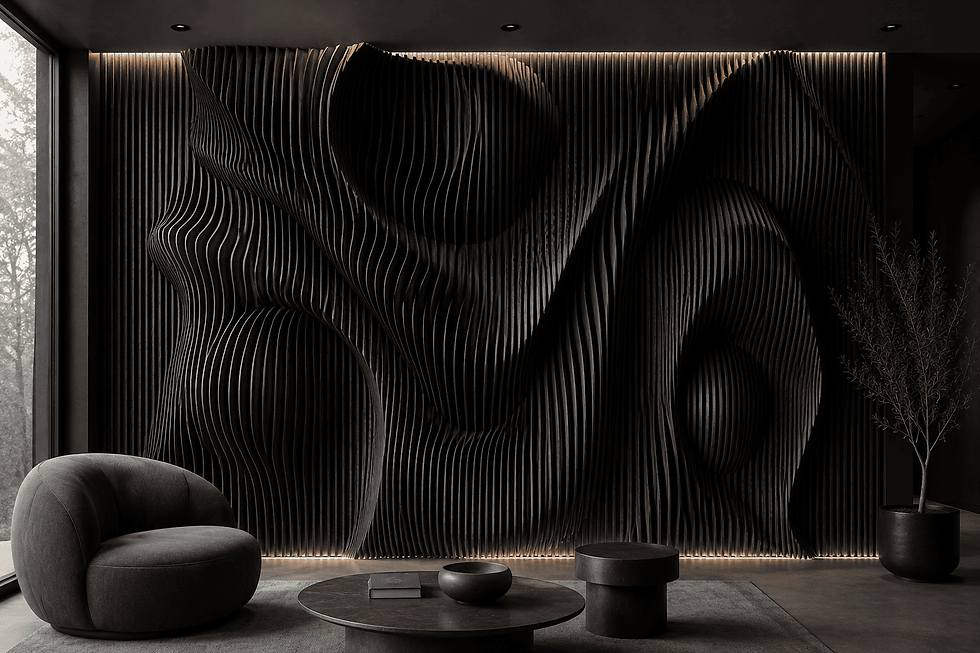
Each component is cut with millimeter-level accuracy. Repetitive elements align perfectly. Complex geometries remain consistent across the entire piece — whether it’s a bench, a reception desk, or a full wall installation.
Unlike traditional furniture, where complexity increases cost and risk, parametric furniture becomes more efficient as complexity grows.
Why Plywood Is the Ideal Material for Parametric Design
Layered plywood plays a critical role in modern parametric furniture.
Its advantages include:
High strength-to-weight ratio
Structural stability
Predictable behavior under CNC machining
Expressive layered edges that become part of the aesthetic
In parametric furniture, the material is not hidden — it is celebrated. The visible layers emphasize depth, rhythm, and craftsmanship, turning structure into visual identity.
Customization Without Compromise (interior design trends)
One of the biggest shifts AI and parametric design bring to furniture is true customization.
Traditional custom furniture often means redesigning everything from scratch. With parametric systems, customization becomes built-in:
Dimensions adapt to space
Forms scale without distortion
Spacing, density, and rhythm adjust to functional needs
Finishes and materials integrate seamlessly
Each piece is unique, yet produced with industrial-level precision.
Parametric Furniture as Architectural Statement

One of the defining interior design trends today is the fusion of furniture and architecture.
Modern interiors increasingly blur the line between furniture and architecture.
Parametric furniture acts as:
Sculptural focal points
Spatial dividers
Functional art
Brand-defining elements in commercial spaces
Reception desks, benches, and wall panels designed parametrically do more than serve a function — they communicate identity, innovation, and design intent.
Why Parametric Furniture Is the Future of Interior Design
Across global interior design trends, parametric furniture stands out as a response to a more thoughtful, architectural approach to space.
The future of interior design demands:
Flexibility
Sustainability
Personalization
Technological integration
Parametric and AI-driven furniture answers all of these needs. It minimizes waste through optimized material usage, adapts to individual spaces, and allows designers and makers to collaborate through shared digital systems.
This is not a trend. It’s a structural shift in how design is conceived and produced.

Designed Digitally. Crafted Physically.
Designed and manufactured in the USA, our work reflects a growing interior design trend toward local production, material honesty, and architectural quality.
At Zorka Furniture, parametric design and CNC technology are not concepts — they are the foundation of our process. Every piece — from sculptural reception desks to architectural wall panels and parametric benches — begins as an algorithmic system and ends as a handcrafted object, made in the USA with precision, intention, and respect for material.
The result is furniture that feels architectural, timeless, and unmistakably modern.
Looking Ahead
As AI tools evolve and digital fabrication becomes even more accessible, the boundary between imagination and production will continue to dissolve. The most compelling interiors of the future will be shaped not by mass production, but by intelligent systems and thoughtful craftsmanship working together.
Parametric furniture is not just changing how things look — it’s changing how design works.


Comments