
How Decorative Wood Wall Panels Create a High-End Interior
Luxury doesn't have to be complicated. In many rooms, the gap between a nice space and a high-end one is a single good decision, and the walls are a sensible place to make it. Decorative wood wall panels have become a big part of that. They add texture, and they also change how the room feels. It ends up warmer and calmer, and it looks finished. A lot of designers have stopped filling rooms with small decor pieces and put one strong, simple wall in their place.
At Zorka Furniture, we make wall panels to fit the room. Whether it's a living room, hotel lobby, office, restaurant or shop, we build the wall around its size, its style and how people use the space. That way it looks like it was always part of the room and wasn't added at the end.

This guide looks at how modern wall panels give a room a high-end look, where they work best, and how a custom installation differs from the standard panels you can buy online.
What Makes a Wood Wall Feel High-End?
Expensive-looking walls are usually not the busiest ones. A few decisions separate a considered wall from a merely decorative one.
Material: Real grain and visible plywood edges bring warmth to rooms full of glass, stone or metal.
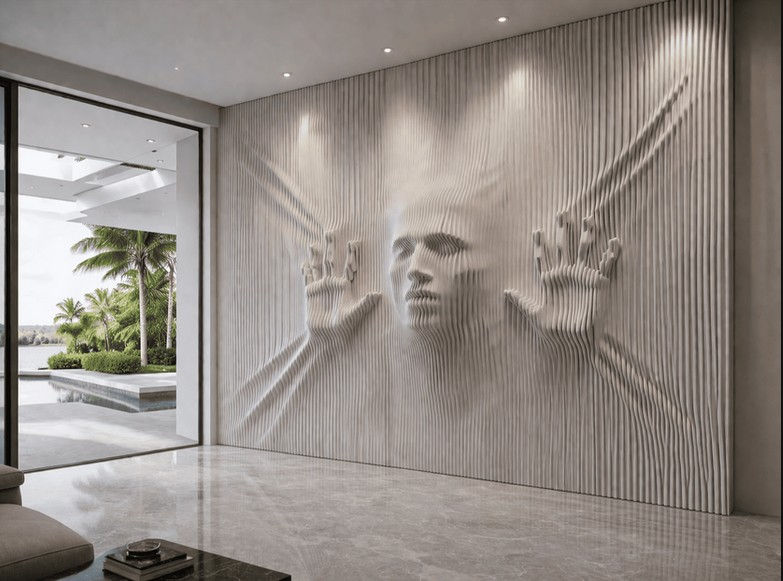
Depth: Shallow relief adds quiet texture. Deeper geometry throws stronger shadows, so the wall reads as sculpture, as with the Helix decorative wood panels.
Rhythm: Evenly spaced elements feel calm, while gradually changing profiles make the eye travel across the surface.
Proportion: A pattern that suits a hotel lobby can feel heavy on a narrow living room wall, so scale it to the room.
Get these four right and the finish becomes the last layer, not a fix.
Decision | What it does in the room |
Material | Adds warmth and a tactile surface |
Depth | Creates shadow and a sculptural feel |
Rhythm | Guides how the eye moves |
Proportion | Keeps the wall in scale with the room |
Finish | Sets colour and how light plays on the grain |
Where Decorative Wood Wall Panels Work Best?
In a living room, the wall often organizes a television, fireplace or shelving. In a bedroom, a softer pattern with shallow depth keeps the wall calm. Commercial spaces are a different matter. A reception wall can carry the company logo, a hotel lobby or restaurant can use bolder sculptural forms to give the room its character, and an office or showroom usually needs the wall to sit comfortably with its furniture and branding. On larger installations, transport and assembly need to be planned early.
Furniture matters too. Well-chosen modern wood furniture can echo the tone, proportion or grain of the wall so the two look planned together.
Materials and Finishes Shape the Character
Our current wall systems use Baltic birch, birch and oak plywood, depending on the design. Baltic birch suits layered, intricate geometry, while oak brings a more pronounced grain. Natural finishes keep the wood in view, stains shift its warmth, and painted finishes move attention to form. The surrounding architecture should guide the choice: warm tones tie in with flooring and furniture, while darker or painted finishes contrast with pale walls.
Light Is Part of the Wall Design
Three-dimensional surfaces change with the light. Daylight gives soft, shifting shadows, and integrated LEDs can pick out profiles and recesses after dark. They aren't always necessary, and our Luma feature wall is offered with or without lighting. The useful question is what the light should reveal. Lighting should show off good geometry, not compensate for weak design.
linear, Geometric or Parametric?
Linear and Geometric Designs
A linear layout gives order and repetition, ideal when you want texture without dominance. Geometric layouts add a stronger pattern. Decorative accent wood is a good way to introduce either one selectively.
Parametric Wall Art
Parametric wall art lets individual elements change gradually in profile, spacing or height, forming waves and flowing transitions. Helix demonstrates how changing profiles and depth can create movement, shadow, and a stronger sculptural presence across a wall.
Custom 3D Parametric Wall
A custom 3D parametric wall makes that form part of the architecture. It suits rooms that need depth and movement, where a flat treatment would leave the wall unfinished.
Decorative Wood Wall Designs to Explore
Design | Style | Best suited to |
Helix decorative wood panels | Flowing parametric relief | Living rooms and feature walls |
Mountain Flow | Parametric wall art | Living rooms and calm focal walls |
Flow of Silence | Decorative wall panels | Quiet, textured backdrops |
Wood Slat Logo Wall | Linear slats with branding | Reception areas and brand spaces |
Two Faces | Modern 3D wall art | Statement walls |
Designing Around TVs, Fireplaces and Shelving
Anything functional should be settled before the geometry is finalized, or it looks like an add-on. A television can sit in a calmer section, with the surrounding geometry gradually getting shallower; fix screen size, viewing height and cable access before fabrication. A fireplace opening must be coordinated with the panel structure, the manufacturer's clearances and surrounding materials so the two read as one composition. Floating shelves work best when they belong to the geometry from the start, and doors and windows should shape the pattern early so it flows around them instead of stopping abruptly.
Branding Built Into the Architecture
A logo doesn't have to hang on the wall like a sign. It can be raised for a tactile effect, recessed for something quieter, or backlit where atmosphere matters. Scale, viewing distance and the surrounding geometry should be decided together. The Wood Slat Logo Wall shows the linear approach, and the Porsche Wood Accent Wall shows how much impact comes from the relationship between geometry, scale, material and space.
When Is Custom Worth It?
Custom earns its place when standard panels can't cope with unusual dimensions, significant depth, integrated furniture, openings, lighting, branding or a specific sculptural idea. For a simple surface treatment in standard sizes, prefabricated panels remain a sensible choice. Custom doesn't have to mean complicated; it means the design answers the space precisely. Our walls are handcrafted and made to order in the USA, with custom dimensions, geometry and finishes.
From Concept to Installation: How a Custom Wall Is Made
Survey the wall's dimensions, depth limits and openings.
Gather photographs, drawings and inspiration images.
Decide the purpose: texture, focal impact, branding or media.
Choose a linear, geometric or parametric direction.
Select material and finish.
Finalize TV, fireplace, shelf, lighting and logo positions.
Build a 3D model to test proportion, depth and sightlines.
Manufacture with CNC precision, then assemble and finish.
Plan sections, packaging, mounting and assembly order.
The 3D model matters most. A flat drawing can't show changing depth or how a sculptural surface meets furniture and openings, so conflicts get caught on screen instead of after production.
Acoustics, Installation and Maintenance
People often assume a wood wall will quiet a noisy room. On its own it usually won't. Wood is hard and bounces sound around much like drywall does, although deep grooves do break up the worst of the echo. Where a restaurant or office needs real absorption, acoustic felt behind the slats is the usual fix, and the NRC rating is worth asking for.
Installation is where many walls go wrong. Deep panels are heavy, so they need to reach the studs or blocking, not bare drywall. Decide early where outlets and switches fall, and leave small gaps between sections because wood moves a little with the seasons.
For upkeep, a vacuum with a soft brush clears dust from the grooves. For a smudge, use a barely damp cloth and dry it straight away. Skip ammonia sprays, and expect strong afternoon sun to lighten the finish over the years.
What Influences the Cost of Decorative Wood Wall Panels?
There is no single price per square foot. Cost follows the full specification, so a simple linear wall and a deeply sculptural one are different projects. Ready-made designs start at the prices listed above; fully custom walls are quoted per project.
Cost factor | Typical impact |
Wall size | High |
Parametric geometry | High |
Depth | Medium to high |
Material and finish | Medium |
TV, fireplace, lighting or branding | Medium to high |
Installation complexity | Medium to high |
Planning a custom wall? Send us your wall dimensions, photos or drawings, preferred finish, and any TV, fireplace, shelving, lighting or branding it needs to include.
Common Mistakes That Make a Wood Wall Look Less Refined
Picking a pattern before studying the wall's proportions
Adding too much depth to a small room
Treating lighting as an afterthought
Adding a TV, shelves or logo after the geometry is fixed
Ignoring doors, windows and transitions
Leaving installation and panel breaks until the end
Create a Decorative Wood Wall Designed Around the Space
Custom decorative wood wall panels can bring together texture, depth, lighting, and architecture in one cohesive feature. Zorka Furniture creates made-to-order wood wall systems with custom dimensions, geometry, and finishes.
Have a wall in mind? Share your dimensions, photos, or drawings with Zorka Furniture to start your custom design.
Frequently Asked Questions
1.Are decorative wood wall panels good for small rooms?
They can be, as long as the relief stays shallow. Deep panels eat into a small room and make the wall look busy, while fine, evenly spaced lines still look neat on a narrow wall.
2.Can the panels be made to fit around a TV or fireplace?
They can. Send the screen size, the mounting height and the fireplace measurements before the design is drawn up, and the panels are cut around them. Check the fireplace manufacturer's clearance instructions as well, since those decide how close the wood can go.
3.What wood are the panels made from?
Baltic birch, standard birch and oak plywood. Baltic birch works well for detailed, layered shapes, and oak shows more grain. Any of them can be left natural, stained or painted.
4.Should I go with custom panels or standard ones?
For an ordinary wall, standard panels usually do the job. Go custom if the wall has odd measurements, a doorway to work around, built-in lighting or a logo, or if you have a particular shape in mind.
5.How do I clean wood wall panels?
Run a vacuum brush attachment or a soft cloth over them to lift the dust. If there's a mark, wipe it with a slightly damp cloth and dry the spot straight away. Harsh cleaners aren't a good idea, and it helps to keep the wall out of direct sun for most of the day, since sunlight can fade the finish.


Comments