
Wood Wall Paneling for Interior & Beachfront Commercial Spaces
- Dec 21, 2025
- 3 min read
Updated: Mar 26

A contemporary architectural perspective
In contemporary architecture and interior design, wood paneling for walls has evolved far beyond decorative cladding. Today, it functions as an architectural system — shaping space, guiding movement, and creating identity. Advances in materials and digital fabrication allow wooden wall panels to perform in environments once considered unsuitable for wood, including high-humidity and coastal locations.
This shift has positioned wood paneling not only as an aesthetic choice, but as a strategic design tool across residential, commercial, and outdoor projects.
Where wood paneling for walls is used today
Residential interiors
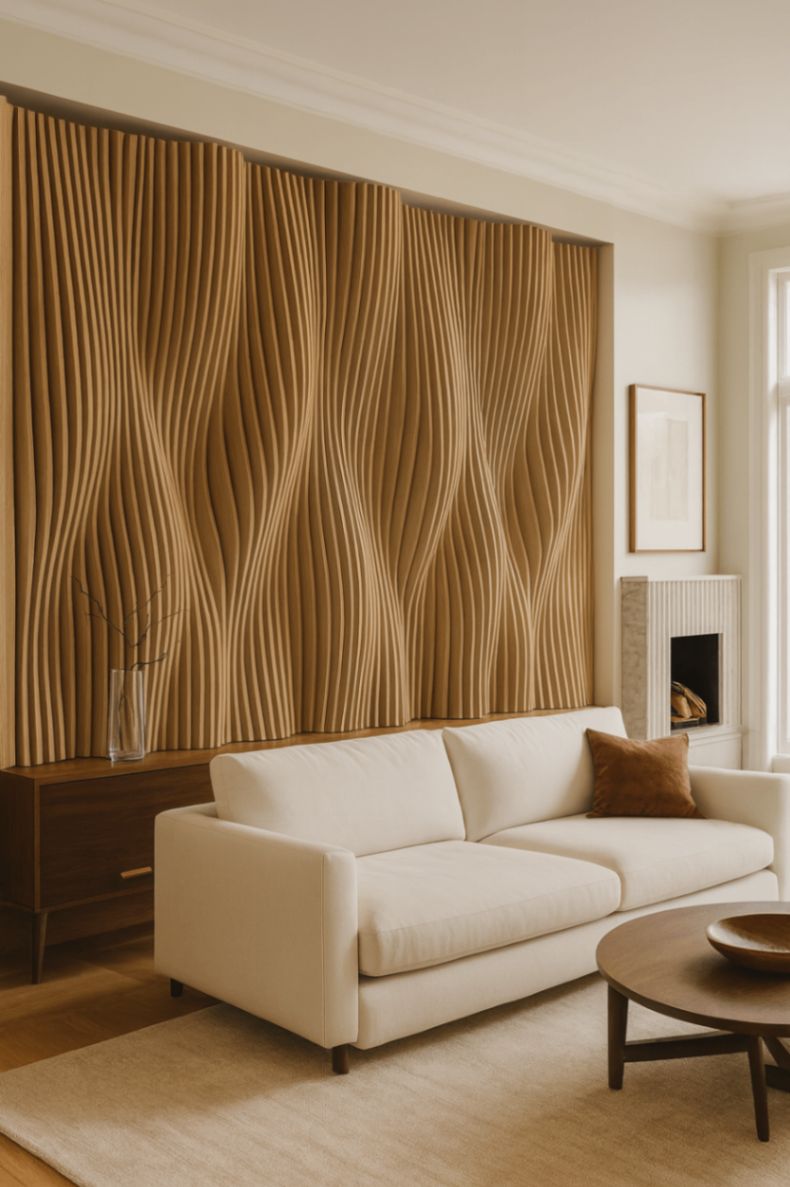
In private homes and apartments, wood paneling for walls introduces warmth, texture, and visual rhythm. Parametric wall systems, in particular, transform flat surfaces into spatial compositions that respond to light and perspective. These solutions are commonly applied in living rooms, media walls, stairwells, and feature corridors, where architecture and atmosphere intersect.
Commercial and hospitality spaces
Hotels, offices, restaurants, and retail interiors increasingly rely on wood paneling to establish a distinctive identity. In reception areas and lounges, wall panels become a brand statement rather than a background element. For hospitality projects, they contribute to both visual impact and acoustic comfort — an often overlooked but critical factor.
Outdoor and coastal environments
One of the most compelling contemporary applications is the use of wood paneling for walls in semi-outdoor and beachfront projects. A recent example from our studio involved a parametric wall designed for a beach bar, located in a high-humidity, salt-air environment.
Through the use of moisture-resistant plywood, marine-grade finishes, and careful detailing, wood becomes not only possible but durable — maintaining its natural character while meeting demanding environmental conditions.

Materials that define performance
Selecting the right substrate is fundamental to long-term success:
Baltic birch plywood
Known for its expressive layered edges and structural stability, ideal for architectural interiors and controlled outdoor environments.
Spartan plywood
Engineered for moisture resistance and dimensional stability, making it suitable for commercial spaces, terraces, and coastal installations.
MDF
Used where flawless surfaces, precision machining, or painted finishes are required, primarily in interior applications.
In beachfront and outdoor projects, these materials are combined with protective oils and marine-grade coatings that preserve texture while resisting moisture, temperature changes, and UV exposure.

Why parametric wood paneling stands apart
Parametric wood paneling for walls is not ornamental by nature — it is systemic. Its value lies in performance as much as appearance:
Creates depth and architectural relief without visual overload
Enhances acoustics in public and commercial spaces
Responds dynamically to natural and artificial light
Can be precisely customized to dimensions, curvature, and function
Such walls evolve throughout the day, offering a changing spatial experience rather than a static surface.
Why “wood paneling for walls” matters
From an architectural standpoint, wood paneling for walls remains one of the most searched and specified solutions in interior and commercial design across the U.S. market. Designers and developers seek systems that combine:
natural materials
architectural clarity
customization flexibility
durability for long-term use
Parametric wood paneling answers all four — making it relevant for projects ranging from private residences to hospitality and outdoor commercial spaces.
A subtle brand note
At Zorka Furniture, we design and fabricate architectural wood paneling systems with a focus on parametric logic, material honesty, and long-term performance. Each wall is custom-engineered — from material selection to finish — to meet the specific spatial, environmental, and visual requirements of the project.
Whether for an interior feature wall, a reception area, or a beachfront bar, our approach remains the same:architecture first, decoration second.

Conclusion
Wood paneling for walls is no longer confined to traditional interiors. With the right materials and design methodology, it becomes a versatile architectural element — equally effective in refined residential spaces, expressive commercial interiors, and demanding outdoor environments.
In this expanded role, wooden wall systems do more than finish a space — they define it.


Comments