
Wooden Bench Design: The Complete Guide to Modern, Custom & Parametric Benches
Updated: Aug 8

The wooden bench is one of the oldest and simplest forms of furniture, yet contemporary design has transformed it into something remarkably sophisticated. What was once primarily a practical place to sit can now become an architectural centerpiece—a sculptural object capable of defining an interior, landscape, lobby, courtyard, or public space.
Modern wooden benches combine functionality with architecture. Clean lines, organic curves, layered geometry, premium materials, and precision manufacturing have expanded what a bench can be and where it can be used.
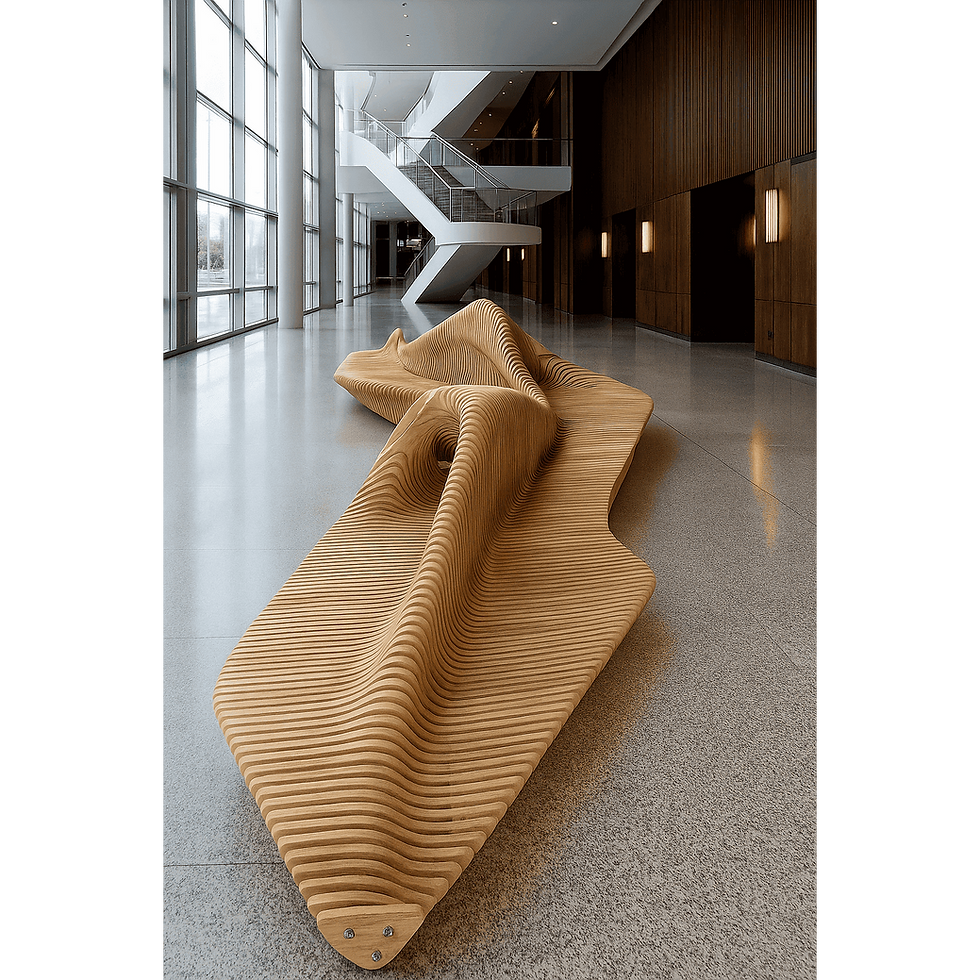
Among the most distinctive examples is the parametric wooden bench, where digital design and precision CNC fabrication make it possible to create flowing forms that would be extremely difficult to achieve through conventional furniture-making techniques.
The result sits somewhere between furniture, sculpture, and architecture.
Whether you are choosing a bench for a private residence, hotel, corporate office, shopping center, university, public plaza, or landscape project, understanding materials, construction, dimensions, finishes, and intended use is essential.
This guide explores how modern wooden benches are designed, what separates custom furniture from mass-produced seating, and what architects, designers, and property owners should consider before selecting a bench for their project.
Why the Wooden Bench Is Being Reimagined
A bench appears simple: a long surface designed to seat several people.
Architecturally, however, it can accomplish much more.
A thoughtfully designed bench can:
Define circulation through a space
Create informal gathering areas
Organize large open interiors
Introduce natural materials
Provide seating without visual clutter
Reinforce an architectural concept
Become a sculptural focal point
Connect furniture with the surrounding landscape
This versatility explains why benches are increasingly used in sophisticated residential and commercial projects.
Instead of placing multiple individual chairs throughout a large space, designers can use one carefully proportioned bench to create a stronger and more cohesive visual composition.
From Functional Seating to Architectural Furniture
Traditional wooden benches were primarily designed around utility. Contemporary benches are increasingly designed around experience.
The difference is visible in their proportions, geometry, materials, and relationship with the surrounding architecture.
Traditional Wooden Bench | Modern Architectural Bench |
Primarily functional | Functional and sculptural |
Straight geometry | Straight, curved, organic, or parametric |
Standard dimensions | Custom project-specific dimensions |
Conventional construction | Precision-engineered construction |
Limited finish options | Extensive finish customization |
Independent furniture piece | Integrated architectural element |
Neither approach is inherently better. A traditional bench may be perfect for a classic garden or simple residential setting.
But when the objective is to create a distinctive contemporary environment, an architectural bench provides designers with considerably more creative freedom.
What Is a Parametric Wooden Bench?

A parametric wooden bench is designed using digital modeling methods that allow complex geometry to be controlled through a system of dimensions, curves, spacing, and relationships.
Instead of drawing every component independently, the designer develops a geometric system from which the individual elements are generated.
For furniture, this makes it possible to create remarkably complex forms while maintaining manufacturing precision.
A typical parametric bench may consist of dozens or hundreds of individually shaped components arranged sequentially to form one continuous three-dimensional surface.
From a distance, the bench appears fluid and sculptural.
Up close, its construction reveals a rhythmic sequence of individual elements.
This contrast between the individual components and the complete form is one of the defining characteristics of parametric furniture.
How Parametric Benches Are Made
The manufacturing process combines digital technology with hands-on craftsmanship.
A typical project moves through several stages:
1. Concept Development
The overall form is established according to the architecture, intended use, available space, and desired visual character.
2. 3D Parametric Modeling
The bench is developed digitally so that proportions, curves, seating areas, structural requirements, and individual components can be evaluated before production.
3. Component Engineering
The digital model is divided into individual manufacturing components and prepared for precision fabrication.
4. CNC Manufacturing
Each component is accurately cut using CNC equipment, allowing complex geometry to be reproduced with consistency.
5. Assembly
The individual elements are carefully aligned and connected to recreate the original three-dimensional form.
6. Hand Finishing
Surfaces and edges are refined before the selected protective finish is applied.
The combination of CNC precision and hand-finishing is important. Technology provides geometric accuracy; craftsmanship determines the quality of the final surface and overall presentation.
Why Wood Works So Well for Parametric Furniture

Wood brings something to parametric design that metal, plastic, and synthetic materials often cannot reproduce: natural warmth.
The geometry may be computational, but the material remains tactile and familiar.
This combination allows parametric furniture to feel futuristic without becoming cold.
Premium wood-based materials also offer important practical advantages:
High structural strength
Excellent dimensional stability
Precision CNC machining
Beautiful layered edges
Broad finishing possibilities
Excellent strength-to-weight performance
Suitability for complex custom geometry
For indoor projects, materials can be selected primarily for appearance, structural performance, and the architectural character of the space.
For an outdoor wooden bench, material selection becomes even more important. Moisture-resistant materials, appropriate hardware, and professional exterior protective systems must be incorporated into the design from the beginning.
Custom Wooden Bench vs. Mass-Produced Bench
One of the most important decisions is whether a standard bench is sufficient or the project requires a custom solution.
Feature | Mass-Produced Bench | Custom Wooden Bench |
Dimensions | Predetermined | Made for the project |
Shape | Standard | Fully customizable |
Materials | Limited selection | Selected for application |
Colors & finishes | Limited | Broad customization |
Architecture integration | Minimal | Designed around the space |
Commercial adaptation | Model dependent | Can be engineered for intended use |
Visual identity | Familiar | Unique |
Branding integration | Rare | Possible |
For straightforward residential applications, a standard bench may be entirely appropriate.
For large commercial interiors, unusual dimensions, curved walls, landscape architecture, or statement installations, custom manufacturing becomes significantly more valuable.
Where Modern Wooden Benches Are Used
The simplicity of the bench makes it one of the most versatile pieces of architectural furniture.
Modern wooden benches can be designed for:
Hotel lobbies
Resorts
Corporate offices
Shopping centers
Retail environments
Universities and campuses
Galleries and museums
Medical and wellness environments
Apartment communities
Restaurants
Residential interiors
Gardens and courtyards
Rooftop terraces
Public plazas
Landscape architecture projects
The design should always respond to the application.
A bench for a private living room does not require the same construction as seating intended for a high-traffic shopping center. Likewise, an outdoor installation has very different material and finishing requirements from an indoor gallery bench.
That distinction should be addressed during design—not after manufacturing.
Indoor vs. Outdoor Wooden Benches
The visual language can remain similar, but the engineering should not.
Consideration | ||
Environment | Climate controlled | Weather exposure |
Moisture resistance | Standard | High priority |
UV exposure | Minimal | Must be considered |
Hardware | Interior appropriate | Corrosion-resistant |
Protective finish | Interior finish system | Exterior protective system |
Maintenance | Generally minimal | Periodic inspection recommended |
Construction | Interior engineered | Designed for exterior conditions |
A quality outdoor wooden bench should therefore never simply be an indoor bench with a different coating applied afterward.
Material selection, construction, hardware, drainage, exposure, and protective finishing should all be considered as part of the original design.
The Designer's Perspective: Start With the Space, Not the Bench
One of the most common mistakes when selecting statement furniture is beginning with the product rather than the architecture.
A better approach is to first understand the space.
Consider:
Where will people approach the bench from?
Which angles will be most visible?
How much circulation space is required?
How many people should it accommodate?
Is the bench intended for short or extended seating?
Does it need a backrest?
Should it visually disappear or become the focal point?
What materials surround it?
How will natural and artificial light interact with the surface?
For sculptural and parametric furniture, these questions become particularly important because the appearance of the bench changes dramatically depending on the viewing angle.
The most successful custom wooden bench is therefore not simply an attractive object placed into a finished room. It is designed in conversation with the architecture surrounding it.
How to Choose the Right Wooden Bench
Choosing a wooden bench should begin with function, scale, and environment rather than appearance alone.
A bench designed for a quiet residential entryway has very different requirements from seating installed in a hotel lobby, shopping center, university, or public outdoor space.
Before selecting or designing a bench, consider five fundamental questions:
Where will the bench be installed?
How many people should it accommodate?
How long will people typically remain seated?
How much daily traffic will it receive?
Will it be exposed to outdoor conditions?
These answers establish the foundation for dimensions, materials, geometry, structural design, and finish selection.
Choosing the Right Bench Style
Modern benches are available in dramatically different configurations, each suited to a different architectural purpose.
Bench Type | Best For | Design Advantage |
Straight Wooden Bench | Hallways, offices, waiting areas | Efficient and versatile |
Curved Bench | Lobbies, public spaces, large interiors | Creates natural circulation |
Parametric Bench | Statement interiors and landscapes | Strong sculptural presence |
Backless Bench | Galleries, malls, open spaces | Accessible from multiple sides |
Bench with Backrest | Waiting areas, hospitality | Greater extended comfort |
Modular Bench | Large commercial projects | Flexible configuration |
Outdoor Bench | Parks, plazas, terraces | Engineered for exterior conditions |
Planter Bench | Courtyards and landscapes | Integrates seating with greenery |
The best configuration is not necessarily the most visually dramatic. It is the one that supports how people naturally move through and use the space.
Ergonomics: A Beautiful Bench Still Needs to Be Comfortable

Sculptural furniture sometimes creates the impression that appearance matters more than comfort.
It shouldn't.
A successful architectural bench needs to work at two scales: visually from across the room and ergonomically when someone actually sits on it.
Important considerations include:
Seat height
Seat depth
Backrest angle
Edge geometry
Lumbar support
Leg clearance
Ease of sitting down and standing up
Spacing between users
For lounge-style seating, deeper seats and more relaxed angles may be appropriate. In waiting rooms and public environments, a more upright position often provides better accessibility and turnover.
This is why proportions should be determined according to intended use rather than copied from another design.
Typical Bench Dimensions
There is no universal size for a modern wooden bench, but common dimensional ranges provide a useful starting point.
Dimension | Typical Range | Design Consideration |
Seat Height | 17–19 in | Comfortable for most adults |
Seat Depth | 16–20 in | Depends on upright vs. relaxed seating |
Width per Person | 20–24 in | More space increases comfort |
Backrest Height | Project-specific | Depends on support and design |
Overall Length | Custom | Based on capacity and architecture |
These dimensions should be treated as design guidelines rather than fixed rules.
A custom bench may require completely different proportions because of its geometry, intended users, or surrounding architecture.
How Long Should a Wooden Bench Be?
Bench length should be determined by both seating capacity and architectural proportion.
As a general planning principle, approximately 20–24 inches of width per person creates comfortable seating.
That means a bench intended for four people might require approximately 80–96 inches of usable seating length.
Large commercial installations can extend significantly farther.
Parametric benches can reach substantial dimensions and incorporate multiple seating zones, curves, transitions, or different seating directions within one continuous structure.
This is where custom manufacturing becomes especially valuable.
Instead of placing several unrelated benches throughout the space, one continuous architectural seating element can organize the entire environment.
Choosing Materials for a Wooden Bench
Material selection affects appearance, strength, maintenance, and longevity.
Rather than selecting material based only on color or grain, professional designers consider the complete application.
Requirement | What to Consider |
Indoor Residential Use | Appearance, tactile quality, finish |
Commercial Interior | Durability and high-traffic performance |
Outdoor Residential | Moisture and UV resistance |
Outdoor Commercial | Weather exposure and intensive use |
Large Parametric Bench | Dimensional stability and structural performance |
Painted Design | Smoothness and compatibility with coating system |
At Zorka Furniture, we use premium high-quality materials selected according to the requirements of each project.
For outdoor furniture, moisture-resistant materials and exterior-grade protective systems are used to provide reliable performance under changing weather conditions.
For indoor furniture, materials are selected for exceptional structural reliability, precise manufacturing, and refined architectural appearance.
Understanding the Finish
The finish is not simply a color applied at the end of production. It is part of the performance system of the furniture.
For indoor benches, available approaches may include:
Natural finishes
Clear protective coatings
Custom stains
Matte finishes
Satin finishes
Painted surfaces
Custom architectural colors
Outdoor benches require additional protection appropriate for exterior exposure.
Depending on the project, this may include:
Moisture-resistant protective systems
UV-resistant coatings
Exterior oils
Multi-layer protective finishes
Custom exterior colors
The correct finish depends on climate, exposure, material, desired appearance, and maintenance expectations.
Commercial Wooden Benches Require Different Engineering

A commercial bench can experience dramatically more use than residential furniture.
Think about seating inside a hotel lobby or shopping center. Hundreds of people may use the same bench every day.
Commercial furniture therefore requires attention to:
Structural reinforcement
Load distribution
High-traffic durability
Hardware selection
Surface protection
Stability
Maintainability
Long-term structural performance
For large architectural installations, engineering becomes part of the design process itself.
The furniture must remain visually refined without exposing unnecessary structural components.
Residential vs. Commercial Wooden Bench
Feature | Residential Bench | Commercial Bench |
Daily Traffic | Low to moderate | Moderate to very high |
Structural Requirements | Standard | Reinforced |
Dimensions | Usually smaller | Often large-scale |
Customization | Aesthetic and functional | Architectural and operational |
Finish Requirements | Residential use | High-traffic durability |
Maintenance | Light | Designed for frequent use |
Primary Goal | Comfort and design | Comfort, durability, and performance |
Understanding this distinction prevents one of the most common furniture specification mistakes: choosing residential-grade construction for a demanding commercial environment.
Designing an Outdoor Wooden Bench
Outdoor furniture introduces additional challenges because the environment constantly changes.
Temperature, moisture, sunlight, rain, humidity, and seasonal conditions all influence materials differently.
A properly designed outdoor wooden bench should therefore consider:
Moisture
Materials and protective systems must be selected for repeated changes in humidity and exposure to water.
UV Exposure
Sunlight can affect both the color and performance of finishes over time.
Hardware
Exterior installations require appropriate corrosion-resistant hardware.
Water Management
The geometry should avoid unnecessary areas where water can remain trapped.
Maintenance
Even high-quality outdoor furniture benefits from periodic inspection and appropriate maintenance.
Outdoor durability is therefore not created by one coating. It results from the entire system—material, construction, hardware, geometry, and finish working together.
Outdoor Bench Applications
Custom outdoor benches can be designed for:
Parks
Public plazas
Hotel landscapes
Resorts
Rooftop terraces
Courtyards
Universities
Corporate campuses
Shopping centers
Apartment communities
Botanical gardens
Residential landscapes
Pool areas
In these environments, the bench often serves two purposes simultaneously: providing seating and becoming part of the landscape architecture.
The Role of Curved and Parametric Benches in Public Spaces
Straight benches naturally create linear seating.
Curved benches behave differently.
They can guide movement, encourage conversation, wrap around architectural features, surround planters, or create social zones within large open environments.
Parametric design expands those possibilities even further.
A single bench can:
Change direction
Vary in height
Transition between seating zones
Integrate a planter
Create openings
Follow surrounding architecture
Form multiple seating orientations
This ability to combine furniture and spatial planning is one reason parametric benches work particularly well in large commercial and public projects.
Integrating Plants into Wooden Benches
One particularly effective approach in contemporary landscape design is combining seating with planting.
A wooden planter bench can wrap around:
Trees
Flowers
Decorative plants
Landscape features
This creates a stronger relationship between furniture and nature while helping organize open spaces.
Integrated planter benches work especially well in:
Courtyards
Hotel landscapes
Shopping centers
Office campuses
Apartment developments
Public plazas
Rather than treating the planter and seating as separate objects, the two become one architectural composition.
Should You Choose a Custom Wooden Bench?
Custom furniture makes the most sense when the architecture demands something that standard products cannot provide.
Consider a custom bench when:
Standard dimensions do not fit the space
You need seating for a specific number of people
The bench must follow a curved wall
The furniture needs to integrate with a planter
You want a distinctive architectural centerpiece
Specific colors or finishes are required
The project involves unusual proportions
Commercial durability is necessary
The bench needs to coordinate with other custom furniture
For these applications, customization is not simply an aesthetic upgrade—it can solve practical architectural problems.
A well-designed wooden bench should feel inevitable within its environment, as though it was always intended to occupy that exact space.
The strongest designs achieve a balance between architecture, ergonomics, materials, and engineering. When those elements work together, a bench stops being simply a place to sit and becomes part of the identity of the space.
Modern Wooden Bench Design Trends
Contemporary bench design continues to move away from furniture as an isolated object and toward furniture as part of the architecture.
For architects, landscape designers, and interior designers, the question is increasingly not simply, “Which bench should we buy?” but rather, “How should seating interact with this space?”
Several design directions are shaping the modern wooden bench.
1. Sculptural Furniture
One of the strongest trends is furniture that functions simultaneously as seating and visual art.
Sculptural benches use:
Flowing geometry
Layered construction
Organic transitions
Asymmetrical forms
Repetition and rhythm
Dramatic changes in depth
The goal is not complexity for its own sake. Successful sculptural furniture creates visual interest while remaining comfortable and functional.
2. Parametric Design
Parametric furniture continues to expand the possibilities of custom manufacturing.
Digital modeling allows designers to develop highly controlled curves and complex three-dimensional surfaces while maintaining precise relationships between individual components.
For a parametric wooden bench, this means that seemingly free-flowing geometry can still be manufactured systematically and accurately.
This approach is particularly effective for large statement pieces in:
Hotel lobbies
Shopping centers
Corporate headquarters
Galleries
Universities
Public spaces
Luxury residences
The bench becomes recognizable not because of applied decoration, but because of its form.
3. Biophilic Design
Contemporary architecture increasingly attempts to strengthen the relationship between people and nature.
Wood naturally supports this philosophy.
Its grain, warmth, tactile character, and visual variation introduce an organic element into interiors dominated by glass, concrete, stone, and metal.
Benches integrated with trees, planters, and landscaping extend this idea further by physically combining seating and natural elements.
4. Large-Scale Seating
Another important trend is the replacement of multiple small furniture pieces with one large architectural seating installation.
Instead of arranging several individual benches in a lobby or public space, designers may specify one continuous sculptural structure.
This approach can:
Create stronger visual identity
Improve circulation
Increase seating capacity
Reduce visual clutter
Organize large spaces
Establish natural gathering areas
For very large environments, furniture begins to behave almost like interior architecture.
5. Indoor–Outdoor Design Continuity
The visual boundary between interiors and landscapes continues to disappear.
Architects increasingly use related forms and materials on both sides of glass walls, terraces, courtyards, and covered outdoor areas.
A modern outdoor wooden bench can therefore share the same architectural language as furniture inside the building while using construction and protective systems appropriate for exterior exposure.
This creates visual continuity without compromising durability.
How to Choose a Wooden Bench: Buying Guide
Before purchasing or commissioning a bench, evaluate the project systematically.
Step 1: Define the Environment
Determine whether the bench will be used:
Indoors
Outdoors
Under a covered exterior area
In a residential environment
In a high-traffic commercial environment
This decision influences nearly every technical requirement that follows.
Step 2: Determine Seating Capacity
Estimate how many people should comfortably use the bench at one time.
Do not calculate only the overall length. Curved geometry, armrests, backrests, and transitions can reduce usable seating space.
Step 3: Evaluate Circulation
Furniture should never interfere with natural movement.
Consider:
Main walking paths
Doorways
Emergency circulation
Adjacent furniture
Access from both sides
Wheelchair accessibility requirements where applicable
For large sculptural benches, circulation should be evaluated during the design stage.
Step 4: Decide How Long People Will Sit
A gallery bench used for several minutes requires different ergonomics from lounge seating where someone may remain for an hour.
Longer seating periods generally benefit from additional back support, greater seat depth, and more relaxed geometry.
Step 5: Select the Design Language
The bench should respond to its architectural environment.
Possible directions include:
Minimalist
Organic
Parametric
Geometric
Sculptural
Linear
Curved
The objective should be harmony rather than simply selecting the most dramatic form.
Step 6: Choose Materials and Finish
Materials should be selected according to performance requirements first and visual preferences second.
For outdoor applications, moisture resistance and weather protection become essential.
For indoor installations, material character, tactile quality, durability, and relationship with surrounding finishes may take priority.
Wooden Bench Buying Checklist
Question | Why It Matters |
Indoor or outdoor? | Determines material and finish requirements |
Residential or commercial? | Determines structural expectations |
How many users? | Establishes required seating capacity |
Short or extended seating? | Influences ergonomics |
Straight or curved? | Affects circulation and interaction |
Fixed or movable? | Influences weight and construction |
Standard or custom size? | Determines manufacturing approach |
What surrounds the bench? | Helps establish visual compatibility |
High-traffic environment? | Requires greater durability |
Custom finish required? | Should be specified before production |
A clear project brief at the beginning usually produces a better result than attempting to modify furniture after the design has already been finalized.
Common Mistakes When Choosing a Wooden Bench
Even beautiful furniture can perform poorly when specified incorrectly.
Choosing Appearance Over Ergonomics
A dramatic design is successful only if people actually want to sit on it.
Form and comfort should be developed together.
Ignoring Scale
A small bench can look insignificant inside a large lobby, while an oversized bench may overwhelm a residential interior.
Furniture should respond proportionally to the architecture.
Treating Outdoor Furniture Like Indoor Furniture
Outdoor performance cannot be achieved simply by applying an exterior coating to furniture originally designed for indoor conditions.
Materials, hardware, construction, geometry, and finishes should all be appropriate for exterior use.
Ignoring Traffic Levels
Furniture installed in a shopping center, university, hotel, or corporate lobby may experience significantly more use than residential furniture.
The construction should reflect that difference.
Choosing Furniture Too Late
For architectural projects, seating should ideally be considered while layouts, lighting, circulation, and finishes are still being developed.
This creates better integration and avoids compromises later.
How to Care for a Wooden Bench
Maintenance requirements depend primarily on environment and finish.
Indoor benches generally require minimal care.
For routine cleaning:
Remove dust with a soft cloth
Use a slightly damp cloth when necessary
Avoid aggressive chemicals
Avoid abrasive cleaning products
Remove spills promptly
Outdoor benches require additional attention because protective surfaces are continuously exposed to environmental conditions.
Periodic inspection is recommended to identify changes in the finish before they develop into larger maintenance issues.
The exact maintenance schedule depends on climate, exposure, finish system, and intensity of use.
Is a Custom Wooden Bench Worth It?
Not every project requires custom furniture.
For straightforward applications, a high-quality standard bench may provide everything needed.
Customization becomes valuable when architecture, dimensions, functionality, or visual identity create specific requirements.
Choose a Standard Bench When... | Choose a Custom Bench When... |
Standard dimensions work | Exact dimensions are important |
The layout is straightforward | Geometry is complex |
Design is secondary | Furniture is a focal point |
Standard finishes are acceptable | Specific colors or finishes are required |
Traffic is moderate | Commercial performance is required |
No integration is necessary | Planters, lighting, or architecture must be integrated |
The objective is not to customize furniture unnecessarily. It is to use customization where it meaningfully improves the project.
Frequently Asked Questions About Wooden Benches

What is a parametric wooden bench?
A parametric wooden bench is a piece of furniture developed using digital modeling methods that control geometry through a system of dimensions and relationships. The resulting design can incorporate flowing curves, layered components, and complex three-dimensional forms while remaining precisely manufacturable.
Can a wooden bench be used outdoors?
Yes. A wooden bench can be designed for outdoor use when appropriate moisture-resistant materials, exterior hardware, construction methods, and protective finishes are incorporated into the project.
What is the best material for an outdoor wooden bench?
There is no single best material for every project. The appropriate choice depends on climate, exposure, bench geometry, structural requirements, desired appearance, and maintenance expectations. High-quality moisture-resistant materials combined with professional exterior protection provide excellent performance for outdoor applications.
Can I order a wooden bench in custom dimensions?
Yes. A custom wooden bench can be designed according to the exact length, width, height, seating capacity, and architectural requirements of the project.
Can a custom bench be curved?
Yes. Curved and organic geometry is particularly well suited to custom and parametric manufacturing. Benches can follow walls, create circular layouts, surround landscape features, or form completely original sculptural configurations.
Are wooden benches suitable for commercial spaces?
Yes. Commercial wooden benches can be engineered for hotels, shopping centers, offices, universities, healthcare environments, restaurants, galleries, and other high-traffic spaces.
Can a bench include a backrest?
Yes. Custom benches can be designed with or without backrests depending on comfort requirements, intended seating duration, and architectural concept.
Can plants or planters be integrated into a bench?
Yes. Custom planter benches can integrate trees, flowers, or decorative planting into the seating composition, making them particularly useful for courtyards, campuses, shopping centers, apartment communities, and landscape projects.
Can lighting be integrated into a wooden bench?
Yes. Depending on the design, LED accent lighting can be integrated into custom benches to emphasize their geometry and create additional visual impact after dark.
How large can a custom wooden bench be?
Custom benches can range from compact residential seating to very large architectural installations. Large projects may be divided into engineered sections or modules to simplify manufacturing, transportation, and assembly.
Are parametric benches comfortable?
They can be extremely comfortable when ergonomics are incorporated into the design. Seat height, depth, curvature, back support, and body positioning should all be considered during 3D development.
How do I maintain an outdoor wooden bench?
Maintenance depends on the protective system and environmental exposure. Regular cleaning and periodic inspection of the finish are generally recommended. Outdoor protective finishes may require maintenance or renewal over time depending on climate and usage.
Can the color of a custom bench be changed?
Yes. Depending on the selected material, benches can be produced with natural finishes, custom stains, protective coatings, painted finishes, or other project-specific architectural colors.
Are custom benches made to order?
Yes. Custom architectural benches are designed and manufactured for the individual project, allowing dimensions, geometry, materials, finishes, and functional elements to be adapted to the space.
Final Thoughts
The wooden bench has evolved far beyond its traditional role as simple seating.
In contemporary architecture, it can become a spatial organizer, gathering point, landscape element, functional sculpture, and defining feature of an interior or exterior environment.
Parametric design expands those possibilities even further. Digital modeling and precision manufacturing allow complex curves, layered structures, and large-scale forms to be transformed into functional furniture while maintaining control over dimensions and construction.
But technology alone does not create good furniture.
The most successful wooden benches balance four elements:
design, comfort, engineering, and craftsmanship.
For residential interiors, that may mean a beautifully proportioned bench that introduces natural warmth without overwhelming the room.
For a hotel or corporate lobby, it may mean a sculptural installation capable of becoming part of the project's identity.
For a park, plaza, campus, or courtyard, it may mean a durable outdoor wooden bench designed around circulation, landscape, and long-term public use.
Ultimately, the best bench is not simply the most unusual one.
It is the bench that feels naturally connected to the architecture, performs reliably in its environment, and continues to look intentional years after it was installed.
That is where custom wooden furniture becomes more than furniture—it becomes part of the space itself.


Comments